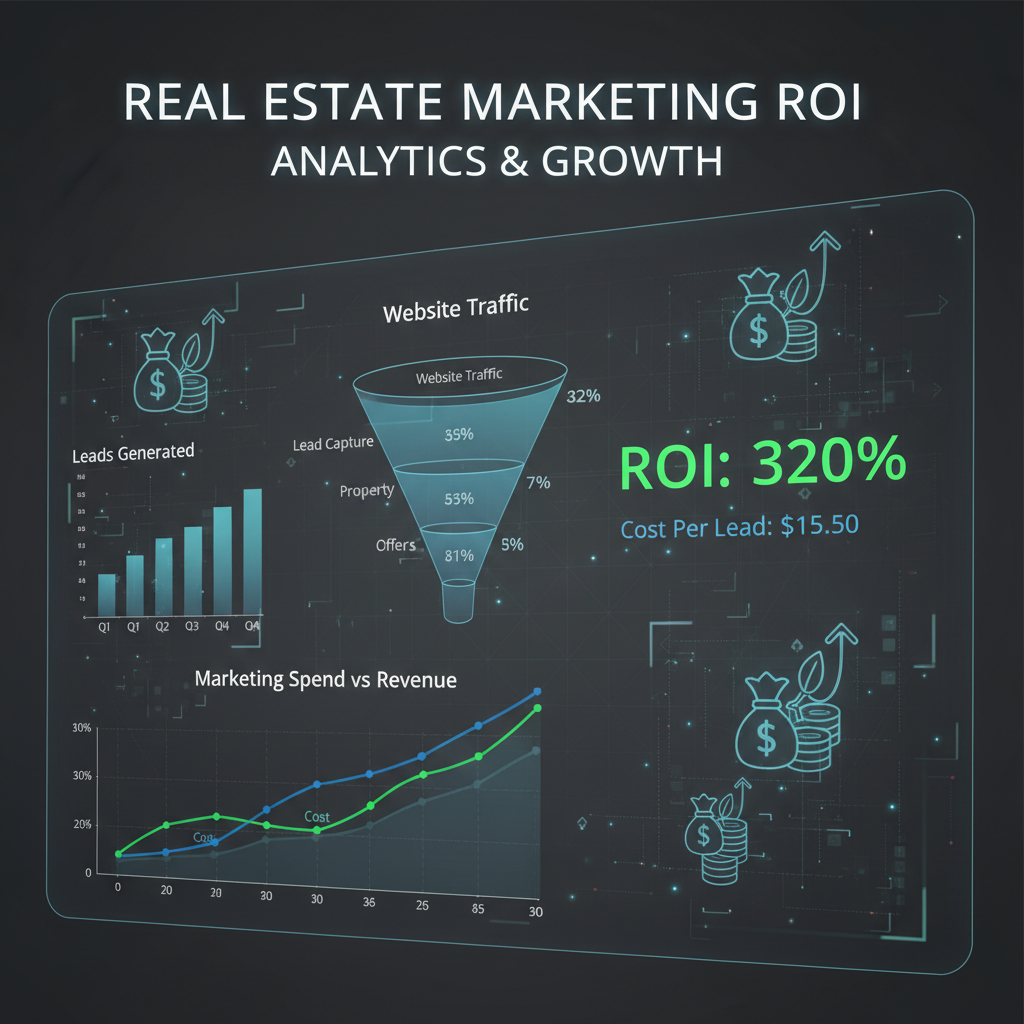
Most real estate agents have no idea what their marketing is actually producing. They spend $1,500 a month on Facebook ads, get a handful of leads, and call it good because their broker said social media is important. That's not a strategy. That's a donation.
If you can't tell me within five minutes what your cost per closed transaction is from each marketing channel, you're flying blind. And flying blind in a high-commission business where one deal can be worth $15,000 or more is genuinely inexcusable.
This guide covers the exact formulas, benchmarks, and tracking setups you need to measure real estate marketing ROI the right way. No theory. Just math.
Why Most Agents Measure the Wrong Things
Before we get into formulas, let's talk about the metrics that don't matter (or at least don't matter as much as you think).
Vanity metrics agents obsess over:
- Impressions
- Reach
- Likes and shares
- Website visitors
- Number of leads
That last one is the trap. Lead volume is seductive because it's easy to optimize for. Buy cheap Zillow leads, get a lot of leads, feel productive. But cheap leads with terrible conversion rates cost you more per closed deal than expensive leads with high intent.
Here's the only hierarchy that matters:
- Cost per lead (CPL) by channel
- Lead-to-appointment conversion rate by channel
- Appointment-to-contract rate
- Contract-to-close rate
- Cost per acquisition (CPA) by channel
- Revenue generated per marketing dollar (ROI)
Everything before #5 is intermediate data. The real answer is always at #6.
The Core Formulas for Real Estate Marketing ROI
Let's get into the math. These are the calculations you need to know cold.
Formula 1: Basic Marketing ROI
```
ROI = [(Revenue from Marketing - Marketing Cost) / Marketing Cost] x 100
```
Example: You spend $2,000 on Google ads in a month. Those ads generate two closed buyer transactions, each netting you $6,000 in commission after splits.
```
ROI = [($12,000 - $2,000) / $2,000] x 100
ROI = [$10,000 / $2,000] x 100
ROI = 500%
```
A 500% ROI means you got $5 back for every $1 spent. Industry standard says 500% (5:1 ratio) is "good." Outstanding is 10:1 or better. Below 3:1, you're likely not covering all your costs once you factor in your time.
Formula 2: Cost Per Lead (CPL)
```
CPL = Total Ad Spend / Total Leads Generated
```
Example: $1,000 in Facebook ad spend, 40 leads.
```
CPL = $1,000 / 40 = $25 per lead
```
Simple. But CPL alone is useless without conversion data layered on top.
Formula 3: Cost Per Acquisition (CPA)
This is the number that actually tells you whether a channel is working.
```
CPA = Total Marketing Spend / Number of Closed Transactions
```
Example: You spend $3,000/month on paid ads and close 1 deal that traces back to those ads.
```
CPA = $3,000 / 1 = $3,000 per transaction
```
If your average gross commission on a closed deal is $8,500 and your CPA is $3,000, that's a healthy margin. If your CPA is $7,000, you're barely breaking even before you account for your time, CRM costs, showing appointments, and transaction coordinator fees.
Formula 4: Lead-to-Close Conversion Rate
```
Lead-to-Close Rate = (Closed Transactions / Total Leads) x 100
```
Example: 200 leads, 2 closed deals.
```
Lead-to-Close Rate = (2 / 200) x 100 = 1%
```
The national average lead-to-close rate sits between 0.4% and 1.2%. Top performers with strong follow-up systems and high-intent traffic hit 5-6%. That gap is enormous when you're doing the CPA math.
Formula 5: Revenue Per Lead (RPL)
```
RPL = Total Revenue from Channel / Total Leads from Channel
```
This one surfaces which channels are sending you high-value clients vs. low-value tire kickers.
Example: Facebook generates 100 leads and produces $18,000 in closed commissions. Google generates 20 leads and produces $16,000.
- Facebook RPL: $18,000 / 100 = $180 per lead
- Google RPL: $16,000 / 20 = $800 per lead
Google's leads cost more (CPL of maybe $70 vs. $18 for Facebook), but they're worth 4x more per lead in actual closed revenue. That's not a CPL problem. That's a quality signal.
Setting Up Attribution: The Part Nobody Wants to Do
None of these formulas work if you can't attribute closed deals back to their original lead source. This is where most agents completely fall apart.
Here's what attribution requires:
1. Tag every lead source at intake. Every time a lead enters your CRM, the source needs to be recorded. Was it a Facebook ad, a Google ad, a Zillow referral, a direct mail response, a sphere referral? That field cannot be blank.
2. Use UTM parameters on every digital ad. When you build a link to your landing page or website in any ad platform, append UTM tags. Format:
```
https://yoursite.com/page?utm_source=facebook&utm_medium=paid&utm_campaign=buyer-leads-q1
```
Your CRM or Google Analytics picks this up and logs which traffic came from where. Without UTMs, Google Analytics lumps everything into "direct traffic" and your data is garbage.
3. Use unique phone numbers per channel. Tools like CallRail ($45/month) assign unique tracking numbers to each ad channel. When someone calls the number on your direct mail postcard, you know. When they call from your Google ad, you know. Separate numbers, separate attribution.
4. Ask every lead and every client. Old-school but still necessary: "How did you hear about me?" Log the answer. Even imperfect human-reported attribution is better than none.
5. Close the loop in your CRM. When a deal closes, go back to that client's record and confirm the original source. Mark it. Run a report quarterly. This is how you find out which channel actually produces revenue, not just leads.
If you're not doing all five of these, your marketing data is fiction.
Benchmarks by Channel
Here's what you should expect from each major channel when it's set up and managed competently. These are industry benchmarks (not best-case-scenario numbers someone used to sell you something).
Facebook / Instagram Ads
Facebook is the most popular paid channel for real estate agents, and for good reason. Volume is there, targeting is strong, and the entry cost is accessible.
| Metric | Benchmark |
|--------|-----------|
| Cost Per Lead (CPL) | $15-$25 (buyer), $25-$45 (seller) |
| Click-Through Rate | 0.9%-1.5% |
| Lead-to-Appointment Rate | 3%-8% |
| Lead-to-Close Rate | 0.5%-2% |
| Typical ROAS | 2.5x-3.5x |
The honest take: Facebook leads are cheap but require serious follow-up infrastructure. You're catching people mid-scroll, not mid-search. Expect 80% of your leads to be low-intent, and build your nurture sequences accordingly. A $20 Facebook lead that closes has a CPA of $1,000-$2,000 when you factor in conversion rates. That's fine if your commissions are $8,000+.
Google Ads (Search)
Google search ads capture people actively searching for a home or agent. Higher intent, higher cost.
| Metric | Benchmark |
|--------|-----------|
| Cost Per Click (CPC) | $2.00-$6.00 |
| Cost Per Lead (CPL) | $50-$100 |
| Lead-to-Appointment Rate | 10%-20% |
| Lead-to-Close Rate | 2%-5% |
| Typical ROAS | 1.4x-3.0x |
The honest take: Google leads are more expensive but convert at 2-4x the rate of Facebook leads. That higher conversion rate equalizes the economics. A $75 Google lead that converts at 3% has a CPA of $2,500. A $20 Facebook lead that converts at 0.8% has a CPA of $2,500. Same CPA, different lead volume, different follow-up requirements.
Where Google gets interesting is seller leads. Someone searching "sell my home in [city]" is a different buyer of attention than someone scrolling Instagram. The intent signals matter.
Programmatic / Display Advertising
Programmatic means buying ad inventory across thousands of websites and apps through automated platforms, targeting by behavior, location, and intent signals. This is where Elorati plays.
| Metric | Benchmark |
|--------|-----------|
| Cost Per Thousand Impressions (CPM) | $4-$15 |
| Click-Through Rate | 0.1%-0.5% |
| Cost Per Lead (CPL) | $35-$80 |
| Lead Quality | Medium-high (intent-based targeting) |
| Brand Recall Lift | 15%-30% |
The honest take: Programmatic's advantage is scale and targeting precision. You can serve ads exclusively to people who've visited home listing sites, searched mortgage terms, or shown moving-intent signals. CPL looks higher than Facebook on paper, but lead quality benchmarks closer to Google. Programmatic also builds brand recognition in your market in a way social ads don't, which creates compounding returns that don't show up cleanly in last-touch attribution.
Don't judge programmatic purely on direct-response CPL. It's doing multiple jobs at once.
Direct Mail
Direct mail isn't dead. It's different.
| Metric | Benchmark |
|--------|-----------|
| Cost Per Piece | $0.30-$0.70 (postcards) |
| Response Rate | 3%-5% |
| Cost Per Response | $10-$25 |
| Cost Per Lead | $25-$100 |
| Average ROI | 112% (per industry data) |
The honest take: Direct mail's superpower is that it's physical. It doesn't get blocked by an ad filter, doesn't disappear into a social feed in two seconds, and hits homeowners in a context (home) where they're thinking about home. Response rates of 4.9% (vs. email's 1%) aren't hype. They're real.
The catch: attribution is harder. Use unique phone numbers or unique landing page URLs on every mailer. Track which list you mailed (geographic farm vs. expired listings vs. FSBOs) separately. Those are different channels that happen to share a delivery mechanism.
The Metric Most Agents Ignore: Lifetime Value
Every benchmark above assumes a transactional view of marketing. One lead, one deal, one commission check. That's incomplete.
Real estate clients buy and sell more than once. They refer family and friends. The agent who built a real relationship with a buyer in 2020 got the listing in 2023 and three referrals in 2024.
Customer Lifetime Value (CLV) formula:
```
CLV = Average Transaction Value x Average Transactions per Client x Average Client Lifespan
```
Example: Your average commission is $8,000. Your average client transacts 2.5 times over 10 years. Some refer one additional client.
```
CLV = $8,000 x 2.5 = $20,000
```
Now recalculate your acceptable CPA. If a client is worth $20,000 over a decade, spending $3,000 to acquire them isn't a 37.5% cost ratio, it's a 15% cost ratio once you account for full lifetime value.
This math is why top producers can profitably outspend everyone in their market. They're not paying for one transaction. They're buying a client relationship.
Building a Simple Marketing Dashboard
You don't need a $500/month analytics platform. You need one spreadsheet or one CRM report with these five columns, tracked by channel:
| Column | What to Track |
|--------|---------------|
| Channel | Facebook, Google, Direct Mail, Zillow, etc. |
| Monthly Spend | Actual dollars spent |
| Leads Generated | New leads this month |
| Deals Closed | Closed transactions traced to this channel |
| Commission Generated | Actual gross commission from those closings |
From those five columns, you can calculate CPL, CPA, and ROI for every channel every month.
Add two more columns and you have a complete picture:
| Column | What to Track |
|--------|---------------|
| Pipeline Value | Active leads in contract or under active nurture |
| Projected Close Rate | Your historical conversion rate for this channel |
Review this dashboard monthly. Kill channels with CPA above your target. Double down on channels below it. Stop making decisions based on vibes.
Target Benchmarks to Set for Yourself
Here's a simple way to set your acceptable thresholds:
Step 1: Calculate your average net commission.
Take your last 12 months of closed volume, subtract commission splits, transaction fees, and any referral fees paid out. Divide by number of transactions. This is your actual per-deal revenue.
Example: $8,500 average gross commission, 40% split with broker, $500 in transaction fees.
Net = ($8,500 x 0.6) - $500 = $4,600 per deal.
Step 2: Set your maximum acceptable CPA.
Most healthy marketing programs run at 15-25% of net revenue. So:
$4,600 x 0.20 = $920 maximum CPA.
If a channel is costing you $920 or less per closed deal, it's earning its keep. If it's costing you $1,800, it needs to either improve or get cut.
Step 3: Work backward to acceptable CPL.
If your lead-to-close rate is 1% and your max CPA is $920:
```
Max CPL = Max CPA x Lead-to-Close Rate
Max CPL = $920 x 0.01 = $9.20
```
That's tight. Which means if your lead-to-close rate is 1%, you need very cheap leads to hit your target CPA. This is the math that tells you whether you have a CPL problem or a conversion problem. Most agents have a conversion problem but keep blaming the ad spend.
If you can get your lead-to-close rate to 3%:
```
Max CPL = $920 x 0.03 = $27.60
```
Now Facebook's $20-25 CPL starts looking profitable. See how conversion rate leverage completely changes the economics?
Common Attribution Mistakes and How to Fix Them
Mistake 1: Crediting the last touchpoint.
Someone saw your Facebook ad, ignored it. Saw your retargeting banner on Zillow, ignored it. Then Googled your name and called. Last-touch attribution gives Google 100% credit. In reality, Facebook created awareness that led to that Google search. Multi-touch attribution tools (even basic ones in HubSpot or Follow Up Boss) split credit more accurately.
Mistake 2: Ignoring time lag.
Real estate has one of the longest sales cycles of any industry. Someone responds to a direct mail piece in January and closes in September. If you're measuring monthly, that January mailer looks like it produced zero results. Track every lead's original source and update it when it closes, no matter how long it takes.
Mistake 3: Measuring only closed deals, not pipeline.
A channel might have zero closes this month but $200,000 in active pipeline. Monthly snapshots miss this. Track pipeline value by source, not just closed revenue.
Mistake 4: Not accounting for seasonality.
Real estate volume peaks in spring and early summer, dips in winter. A channel that looks bad in January might be performing exactly as expected. Compare month-over-month against the same month last year, not just the prior month.
Mistake 5: Confusing marketing spend with total acquisition cost.
Your CPA should include: ad spend + time spent on follow-up (at your hourly rate) + CRM costs allocated to that campaign + any ISA costs. If you're spending 20 hours per month following up on Facebook leads, that's not free. At $100/hour, that's $2,000 in time cost that needs to be in the denominator.
The Tools You Actually Need
You don't need the full MarTech stack. You need four things:
1. A CRM with source tracking. Follow Up Boss, Sierra Interactive, or even HubSpot's free tier. The source field must be required. Non-negotiable.
2. UTM parameters on every ad link. Free. Built into every ad platform. Takes five minutes to set up. No excuse not to.
3. Call tracking. CallRail ($45/month) or similar. Unique numbers per channel. Especially important for direct mail and offline attribution.
4. A monthly tracking spreadsheet. Even Google Sheets. Five columns. Reviewed monthly. Acted on quarterly.
That's it. Don't buy a $300/month attribution platform until you've maxed out what you can learn from a spreadsheet. Most agents haven't.
What Good Looks Like: A Real Example
Here's a clean example of a well-tracked marketing program for a solo agent in a mid-size market:
Monthly budget: $2,500
| Channel | Spend | Leads | Closes (trailing 90-day avg) | Commission | CPA | ROI |
|---------|-------|-------|-------------------------------|------------|-----|-----|
| Google Ads | $900 | 12 | 0.8 | $6,800 | $1,125 | 656% |
| Facebook Ads | $600 | 35 | 0.6 | $5,100 | $1,000 | 750% |
| Direct Mail | $700 | 8 | 0.5 | $4,250 | $1,400 | 507% |
| Zillow Premier | $300 | 6 | 0.3 | $2,550 | $1,000 | 750% |
Total: $2,500 spend, 1.9 avg closes/month (trailing average), $11,475 avg commission.
Overall marketing ROI: 359%
Every channel in this example is producing a positive ROI. But notice the variance. Direct mail has the highest CPA at $1,400 and the lowest ROI at 507%. Should they cut it? Maybe. Depends on whether those direct mail leads skew toward sellers (higher commission values) and whether there's a longer-term brand equity play in their farm area.
This is what informed marketing decisions look like. Not gut feelings. Not "my coach told me to do Facebook." Numbers.
The Real Estate Marketing ROI Benchmarks Summary
Save this. Reference it monthly.
| Channel | CPL Range | Lead-to-Close Rate | Target CPA | Expected ROI |
|---------|-----------|-------------------|------------|--------------|
| Google Search | $50-$100 | 2%-5% | $1,500-$3,000 | 3x-6x |
| Facebook/Instagram | $15-$45 | 0.5%-2% | $750-$2,500 | 3x-8x |
| Programmatic Display | $35-$80 | 1%-3% | $1,200-$3,500 | 2x-5x |
| Direct Mail | $25-$100 | 2%-5% | $800-$2,500 | 2x-5x |
| Zillow/Realtor.com | $20-$60 | 1%-3% | $700-$2,500 | 3x-7x |
| Email Nurture | $5-$20 | 3%-8% | $250-$500 | 10x+ |
Email nurture has the best economics on paper because you're working a list you already paid to build. The CPL looks low because the acquisition cost was already paid at the top of the funnel.
Stop Waiting. Start Measuring.
Here's the reality: you can read this entire guide, nod along, and still be running blind in 90 days because you didn't actually implement the tracking.
The only thing that separates an agent who knows their marketing ROI from one who doesn't is whether they spent two hours this week setting up source fields, adding UTMs to their ads, and building a simple tracking spreadsheet.
That's it. Two hours. Against the backdrop of spending $1,500-$3,000 a month on marketing you can't evaluate.
Pick one channel. Pull the last 90 days of spend. Count how many deals came from it. Do the math. Then do that for every channel.
You'll probably be surprised. Not always pleasantly. But at least you'll know.
And knowing is where all good marketing decisions start.
Frequently Asked Questions
What is a good marketing ROI for real estate agents?
A 5:1 return (500% ROI) is considered strong, meaning for every $1 you spend you generate $5 in commissions. Most well-run paid campaigns fall in the 3x-7x range. Anything below 3:1 is worth scrutinizing hard, especially once you factor in your time as a cost. Anything consistently above 8:1 means you're either underinvesting (you should be spending more) or your tracking is off.
What's a realistic cost per lead for real estate advertising?
It depends entirely on the channel and market. Facebook leads average $15-$45 for buyers, $25-$60 for sellers. Google search leads run $50-$100. Direct mail responses come in at $25-$100 per lead depending on the list and mailing frequency. The number that actually matters isn't CPL in isolation. It's CPL divided by your conversion rate, which gives you CPA. Judge channels by CPA, not CPL alone.
How do I track which marketing channel is generating my closed deals?
You need four things: (1) a CRM that requires a lead source field at intake, (2) UTM parameters on every paid ad link, (3) unique tracking phone numbers per offline channel, and (4) discipline to update the source field when a lead closes, no matter how long the pipeline took. Without all four, your attribution data will be incomplete.
How long should I run a marketing channel before evaluating its ROI?
At minimum, 90 days for digital channels like Facebook and Google. Six months for direct mail, because responses can be delayed and the compounding effect of repeat mailings takes time to show up. Real estate has a long sales cycle. Don't kill a channel after one month of data. Kill it after 90-180 days of consistent data that shows CPA above your acceptable threshold.
What's the difference between ROAS and ROI in real estate marketing?
ROAS (Return on Ad Spend) only counts the ad cost in the denominator: Revenue / Ad Spend. ROI accounts for all marketing-related costs including your time, CRM fees, creative production, and any staff costs. ROAS will always look better than ROI. Use ROAS as a quick platform benchmark. Use full ROI as your actual business metric. An agent with a 5x ROAS but who's spending 30 hours/month managing leads might have a 1.5x ROI once time is properly valued.
This guide provides educational information based on industry research and case studies. Individual results will vary based on market conditions, budget, and execution.