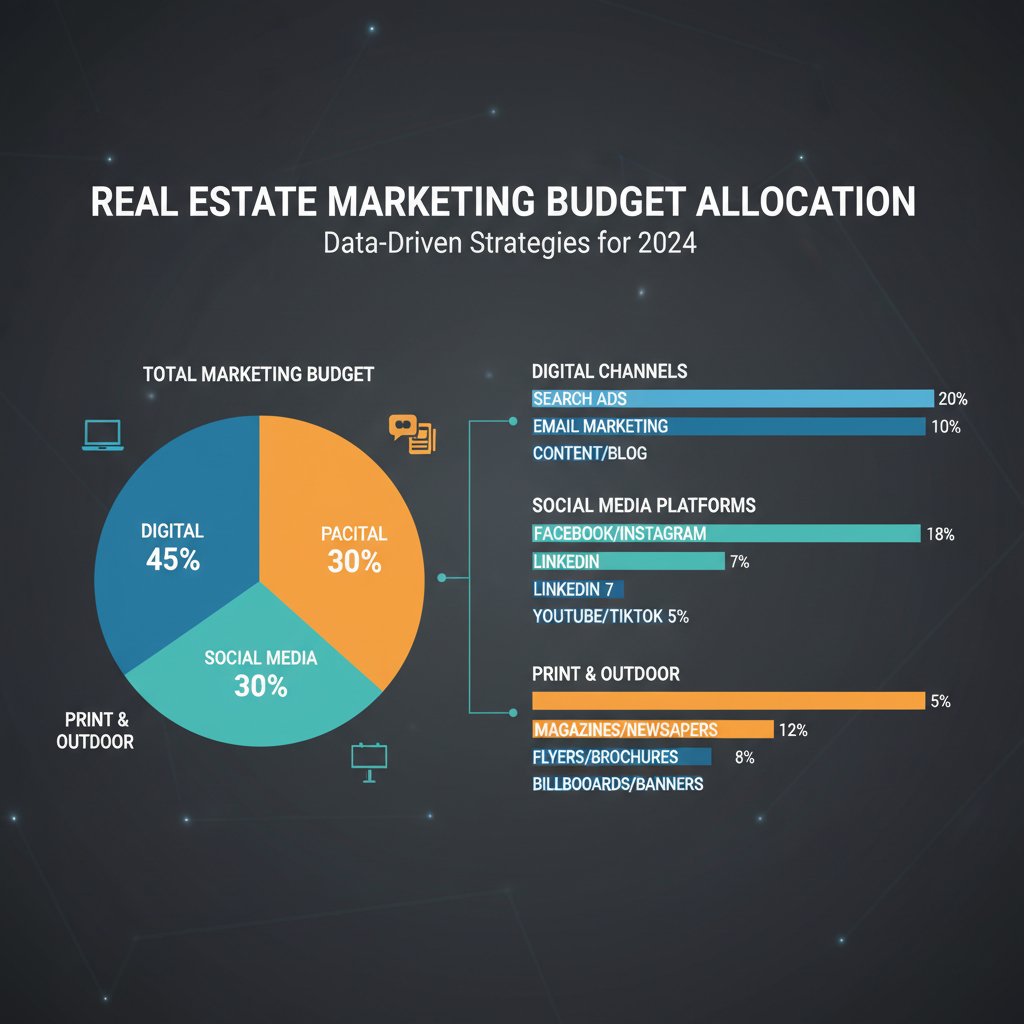
Most agents don't have a marketing budget. They have a vague number in their head and a pile of receipts they sort out in April.
That's not a strategy. That's hoping.
The average real estate agent spent $14,200 on marketing in 2024, according to NAR data. Some of those agents got a real return on that money. Most didn't. The difference wasn't how much they spent. It was whether they actually knew where it went and what it produced.
This guide is the breakdown you need before you commit a dollar to anything in 2026. We're going channel by channel, agent type by agent type, with real numbers. No motivational fluff. No "it depends." Specific figures, specific decisions.
Let's get into it.
The Baseline: What Agents Actually Spend
Before you decide what you should spend, you need to know what the market looks like.
Here's the current picture:
- Average realtor marketing spend (2024): $14,200/year (NAR)
- Most common range: $10,000 to $20,000/year
- Monthly digital marketing spend (majority of agents): $100 to $499/month
- Agents spending $20,000+ annually: tend to have already optimized their mix and hold steady
- Rule of thumb most coaches push: 7% to 12% of gross revenue reinvested in marketing
That last one is the one worth anchoring to. If you're doing 10 deals at $400,000 average price with a 2.5% buyer-side commission, you're generating $100,000 GCI before broker split. At a 70/30 split, you're taking home $70,000. A 10% marketing allocation means $7,000/year. That's your floor, not your ceiling, especially if you're trying to grow.
If you're doing 15 deals at higher price points, that number climbs fast. A $250,000 GCI agent running 10% to 12% is putting $25,000 to $30,000 into marketing. At that level, sloppiness gets expensive.
The key question isn't how much to spend. It's whether what you're spending is tracked to outcomes. If you can't tell me your cost per lead, your cost per contract, and your cost per closed deal for each channel, you don't have a marketing budget. You have a marketing expense.
Budget by Agent Type: Three Models
Not every agent is the same. Here's how the numbers break down across the three archetypes most relevant to this conversation.
Solo Agent: 8-15 Deals/Year
Annual GCI target: $75,000 to $150,000
Recommended marketing budget: 10% to 12% of GCI
Target range: $7,500 to $18,000/year ($625 to $1,500/month)
This is the most common profile. You're running a real business, but you're doing it alone. That means your budget has to work harder than someone with a team behind them. You can't afford to spray money across eight channels and monitor all of them. You need two to three channels that you own deeply.
Where solo agents typically allocate:
| Channel | Monthly Spend | Annual Total | % of Budget |
|---|---|---|---|
| Digital advertising (Google/Meta) | $300-$600 | $3,600-$7,200 | 35-40% |
| CRM + marketing automation | $100-$200 | $1,200-$2,400 | 12-15% |
| Website + IDX platform | $79-$200 | $950-$2,400 | 10-12% |
| Content/SEO | $100-$300 | $1,200-$3,600 | 10-15% |
| Direct mail | $200-$400 | $2,400-$4,800 | 20-25% |
| Professional photography/video | $150-$300 | $1,800-$3,600 | 12-15% |
The big mistake solo agents make: they subscribe to too many platforms. They've got a CRM, a social media scheduler, a direct mail service, a video tool, a landing page builder, and a Zillow Premier Agent subscription, and none of them are being used to their potential. Kill the subscriptions that aren't producing trackable leads. Consolidate.
Real Estate Team: 25-50+ Deals/Year
Annual team GCI target: $400,000 to $1,000,000+
Recommended marketing budget: 8% to 12% of team GCI
Target range: $32,000 to $120,000/year
At the team level, you've got the volume to test channels and the budget to let some experiments fail. The allocation shifts meaningfully here.
Where teams typically allocate:
| Channel | Monthly Spend | Annual Total | % of Budget |
|---|---|---|---|
| Digital advertising (Google/Meta/YouTube) | $2,000-$5,000 | $24,000-$60,000 | 40-50% |
| CRM + marketing automation | $300-$800 | $3,600-$9,600 | 8-10% |
| Website + IDX + SEO | $500-$1,500 | $6,000-$18,000 | 12-15% |
| Direct mail + farming | $500-$1,500 | $6,000-$18,000 | 12-15% |
| Video production + social | $500-$1,000 | $6,000-$12,000 | 8-12% |
| Lead portals (Zillow/Realtor.com) | $500-$2,000 | $6,000-$24,000 | 10-15% |
Teams can justify portal leads in a way solo agents often can't. The math only works when you have a system to follow up on every lead, fast. Studies consistently show that leads contacted within five minutes convert at dramatically higher rates than leads contacted even an hour later. If you don't have that infrastructure, portal leads are a money pit.
Luxury Agent: $1M+ Listings
Annual GCI target: $300,000 to $1,000,000+
Recommended marketing budget: 15% to 27% of net commissions
Per-listing marketing: 0.25% of list price for properties over $2M
Luxury is a different game. The commission margin is higher, which means you can spend more per transaction and still come out ahead. The bigger issue is that luxury buyers and sellers don't respond to the same tactics as general real estate clients.
They don't care about your Facebook ad. They do care about your photography, your network, and whether you look like someone who belongs in their world.
Where luxury agents typically allocate:
| Channel | Monthly Spend | Annual Total | % of Budget |
|---|---|---|---|
| Professional photography/videography/3D | $2,000-$5,000 | $24,000-$60,000 | 25-35% |
| Print marketing (magazines, mailers, brochures) | $1,500-$4,000 | $18,000-$48,000 | 20-25% |
| Digital advertising (highly targeted) | $1,500-$3,000 | $18,000-$36,000 | 18-22% |
| Website (Luxury Presence or equivalent) | $500-$1,000 | $6,000-$12,000 | 6-8% |
| Events and client experiences | $1,000-$3,000 | $12,000-$36,000 | 12-18% |
| PR and media placements | $500-$2,000 | $6,000-$24,000 | 6-10% |
One example from the industry: an agent with $24.5M in annual sales was investing between $88,200 and $132,300 per year in advertising, roughly 27% of net income. That sounds aggressive until you realize those listings weren't going to sell themselves off a Canva post.
For a $5M listing, 0.25% means $12,500 in listing-specific marketing. That's custom video, high-end print collateral, targeted digital, and syndication. That's table stakes at that price point.
Channel-by-Channel Cost and ROI Analysis
Here's the breakdown every agent needs before they write a single check.
Google Ads (Search + Display)
Average cost per lead: $50 to $150
Average monthly minimum to matter: $500 to $1,000
Conversion rate (lead to transaction): 1% to 3%
Google Ads work because buyers and sellers searching "homes for sale in [city]" or "best real estate agent in [city]" have demonstrated intent. You're not interrupting them. You're answering a question they already have.
The catch is competitive. In major metro areas, real estate keywords are expensive. You're bidding against Zillow, Realtor.com, and other agents with larger budgets. You need a good landing page and a fast follow-up system, or the cost per acquisition blows up.
Best for: Agents in mid-tier markets who want lead volume. Less efficient in high-competition metros unless you're hyper-targeted by neighborhood.
Meta Ads (Facebook + Instagram)
Average cost per lead: $5 to $40 (depending on targeting and offer)
Average monthly minimum to matter: $300 to $600
Conversion rate (lead to transaction): 0.5% to 2%
Cheaper leads, lower intent. That's the trade-off. Meta leads are generated through interruption (someone scrolling sees your ad), not through search intent. They require more nurturing and longer conversion cycles.
The agents who win on Meta are the ones treating it as a top-of-funnel awareness play, not a direct lead close. You run a home valuation ad, collect an email, put them in a CRM sequence, and work the relationship over 6 to 12 months.
Best for: Agents with a real CRM follow-up system and patience for a longer sales cycle. Also excellent for geographic farming and staying top-of-mind with past clients.
92% of U.S. realtors use Facebook for some form of marketing. Most are wasting money on it. The ones who aren't have a process on the back end.
Zillow Premier Agent
Average cost per lead: $20 to $220+ (varies wildly by ZIP code)
Metro market cost per lead: $150 to $220+
Conversion rate (lead to transaction): 1% to 5%
Zillow is the most controversial spend in real estate marketing. Agents either swear by it or hate it. The split usually comes down to follow-up speed.
Zillow's own internal data shows that the agents who respond to leads within two minutes convert at 3x the rate of those who respond within an hour. If you're not set up to respond in two minutes, don't buy Zillow leads. You'll pay premium prices and convert at the lowest possible rate.
The Zillow Flex model is worth understanding separately. Instead of upfront costs, you pay 15% to 40% of your commission on closed deals. That's a high success fee, but the leads are theoretically higher quality and there's no cash out of pocket until close.
Best for: High-volume agents with dedicated ISAs or immediate follow-up systems. Not a solo agent's first spend.
Email Marketing
Average cost per lead: $3 to $15
Average ROI: $36 to $42 per $1 spent (some studies cite up to $40 return)
Cost of tools: $20 to $200/month depending on list size
Email has the best ROI of any marketing channel in real estate, and most agents barely use it. That is a massive, free opportunity you're leaving on the table.
The playbook is simple. Build a list of past clients, current prospects, and sphere of influence contacts. Send value consistently: market updates, neighborhood stats, sold data, home maintenance tips. Don't sell every email. Build the relationship.
When someone in your database is ready to buy or sell, you're the agent they think of because you've been showing up in their inbox every month for two years.
Best for: Every agent. There's no agent type for whom email isn't worth doing. If you're not doing this, start immediately.
Direct Mail (Farming)
Average cost per piece: $0.35 to $1.50
Average cost per lead: $25 to $100
Recommended minimum commitment: 6 to 12 months, same farm area
Direct mail works through repetition. One postcard does nothing. Twelve postcards to the same 500 households over 12 months, consistently, builds name recognition and market share in a geographic farm.
The math: 500 homes, $0.75 per piece, 12 mailings per year = $4,500 annually. If that farm turns over 5% annually (25 listings), you need to close 2 to 3 of those listings to justify the spend at average commission rates. Achievable if you're consistent and your materials don't look like they were made in 2009.
Direct mail conversion is slow, but it compounds. The agent who's been farming a neighborhood for three years has a massive advantage over anyone who just started.
Best for: Agents willing to commit for the long haul. Not a quick-win channel.
SEO and Content Marketing
Average monthly investment: $200 to $1,500
Time to meaningful traffic: 3 to 6 months
Time to substantial lead generation: 6 to 12 months
SEO is the investment that most agents either ignore completely or spend too much on too early without a plan. It's a long-term play. You're not going to rank for "homes for sale in Salt Lake City" against Zillow. That battle is lost before it starts.
What you can rank for: hyperlocal content. Neighborhood guides, local market reports, school district breakdowns, "best neighborhoods for families in [city]" type queries. Those are searches where you can beat the portals because you actually know the market.
A basic SEO setup for an agent includes a fast website with IDX, location-specific landing pages, and a content calendar. That's $1,000 to $2,000 upfront and $200 to $500/month to maintain.
Best for: Agents playing a 12+ month game. Pairs well with content creation. If you're not consistent, don't start.
Professional Photography and Video
Average per listing (photography): $150 to $400
Average per listing (video/walkthrough): $300 to $800
3D virtual tour: $200 to $500 per listing
This isn't optional. Listings with professional photography sell faster and for more money. Multiple studies put the premium at $3,000 to $11,000 on average price versus amateur photos, depending on price point.
At a $500,000 listing, if professional photography results in even a $3,000 higher sale price, the seller wins and so do you (slightly higher commission). The $300 you spent on photos paid for itself and then some.
For video, the bar is rising. Buyers expect walkthrough video, especially for anything over $500,000. If your competition has video and you don't, you're at a disadvantage before the showing happens.
Best for: Every single listing. This is non-negotiable. Budget per listing, not as an annual line item.
Lead Portals (Realtor.com, Homes.com)
Realtor.com: $200/month for shared leads; $1,000/month for exclusives
Average cost per lead: $25 to $45
Homes.com: Newer player, pricing varies; currently aggressive to gain market share
Realtor.com operates on a different model than Zillow. Their leads tend to be slightly lower cost but also lower volume. If you've been burned by Zillow costs, Realtor.com is worth evaluating as an alternative.
Homes.com is making a significant push in 2026 with CoStar money behind them. Worth watching. Their acquisition costs are competitive right now as they build out their agent network.
Best for: Agents who've exhausted organic channels and want to buy volume. Requires the same fast follow-up as any portal lead.
The Channels Most Agents Underweight
Before we talk about where to cut, let's talk about what's chronically underfunded.
Past client marketing. Your existing clients are the highest-ROI marketing you can do. They already like you, trust you, and know people who buy and sell homes. Staying in touch costs almost nothing: a quarterly call, a birthday card, a market update email, an annual check-in. Agents who systematically stay in touch with their past clients generate 20% to 40% of their business from referrals. Agents who don't wonder why they're always chasing cold leads.
If you're spending $200/month on Facebook ads and zero on past client nurturing, you have your priorities backward.
Video content. Not production video. Not polished walkthroughs. Real, educational, consistently posted video: market updates, neighborhood breakdowns, buyer education, seller tips. It builds trust faster than any other medium, it lives on YouTube and Instagram indefinitely, and the production cost is essentially zero if you're willing to show up on camera.
Most agents avoid it because they're uncomfortable on camera. That discomfort is protecting you from competition that would otherwise crush you.
What to Cut
Not everything deserves a dollar. Here's where money gets wasted:
Boosted social posts. Boosting a "Just Listed" post is not a strategy. You're paying for impressions to people who mostly don't care. If you want to advertise on Meta, run structured campaigns with specific targeting and a clear call to action. Random boosting is feel-good spending with minimal return.
Overpriced lead services. There are dozens of companies selling real estate leads at $40 to $200 each that are recycled, unqualified, or already being sold to three other agents simultaneously. If a lead provider can't give you exclusive leads with clear attribution data, move on.
Dead CRM subscriptions. If you have a CRM you're paying for but not actively using, cancel it. The cost isn't the issue. The opportunity cost is. You're telling yourself you have a follow-up system when you don't, which means you're not fixing the actual problem.
Print advertising in declining publications. Local magazines and newspapers charge premium rates for diminishing readership. Unless you're targeting luxury clients who actually read print (some do), the cost-per-impression math doesn't hold up.
The 2026 Budget Framework
Here's a simple framework for building your marketing budget before you make any commitments.
Step 1: Set your GCI goal.
Not what you made last year. What you want to make this year. That's the number you work backward from.
Step 2: Allocate 10% to 12% of that number to marketing.
If your goal is $120,000 GCI, your budget is $12,000 to $14,400. If your goal is $200,000 GCI, it's $20,000 to $24,000.
Step 3: Assign every dollar before you spend it.
Not roughly. Specifically. "$300/month to Meta ads, $400/month to Google, $150/month to CRM, $250/month to direct mail." Write it down. Commit to it for 90 days minimum before changing anything.
Step 4: Track cost per lead by channel.
Every lead that comes in, log where it came from. At the end of 90 days, you'll know which channels are producing and which are waste.
Step 5: Kill the losers, double down on winners.
Once you have data, act on it. Don't keep spending on a channel out of habit or because someone told you it works. If your own numbers say it doesn't work for you, stop.
Step 6: Revisit quarterly.
Markets shift, platforms change pricing, and what worked in Q1 may not work in Q3. This isn't a set-it-and-forget-it document.
What Top Agents Actually Do Differently
High-performing agents aren't necessarily spending more. They're spending smarter. Here's what separates the top 10% of marketers in this industry from everyone else.
They diversify across at least 4-5 channels. Agents using five or more marketing channels report average GCI of $4 million, versus well under $100,000 for agents relying on one or two. Diversification isn't about hedging. It's about showing up in more places than your competition.
They treat marketing like math, not art. Every dollar has a destination. Every channel has a metric. "Brand awareness" that can't be tied to anything measurable isn't a strategy, it's an excuse.
They invest in relationships, not just leads. Past client programs, referral incentives, client events, and consistent communication consistently deliver the highest ROI of any marketing activity. It's the least glamorous part of the budget and the most important.
They don't chase trends without data. TikTok for real estate? Maybe. But top agents don't move budget to a new channel until they see evidence it converts for their market. Early adopter advantage is real. Wasting money on a platform that doesn't fit your ICP is also real.
They budget for listing marketing separately. This is a discipline most agents skip. Listing marketing (photography, video, print collateral, advertising for a specific property) should be budgeted as a cost of doing business, not drawn from your general marketing fund. Know your per-listing cost and price it into your value proposition.
FAQ
How much should a realtor spend on marketing?
The industry standard is 7% to 12% of your gross commission income. For an agent earning $100,000 GCI, that's $7,000 to $12,000 per year. For someone earning $250,000 GCI, it's $17,500 to $30,000. New agents building their brand should skew toward the higher end of that range. Established agents with strong referral bases can often sustain business at the lower end.
What is the best marketing channel for real estate agents in 2026?
Email marketing delivers the highest ROI at roughly $36 to $42 returned per dollar spent. But ROI alone doesn't tell the whole story. Email only works if you have a list. For agents building their business from scratch, a combination of targeted digital advertising (Meta or Google) for lead acquisition and email for nurturing will outperform any single channel. No single channel is "best" in isolation.
Is Zillow worth the cost for real estate agents?
Zillow can work, but only for agents with the infrastructure to respond to leads in under two minutes and the follow-up systems to nurture long sales cycles. In competitive metro markets, Zillow leads cost $150 to $220+ each with conversion rates of 1% to 5%. Do that math before you subscribe. If your follow-up is inconsistent, you'll convert at the low end of that range and lose money.
How do luxury real estate agents allocate their marketing budget differently?
Luxury agents spend significantly more per transaction, with listing marketing budgets typically set at 0.25% of list price for properties over $2M. Print, professional media, and client experience events take up a larger share of the budget. High-end photography and video aren't optional: they're the minimum expectation. Overall, luxury agents may invest 15% to 27% of their net commission income back into marketing.
How often should I review my real estate marketing budget?
Quarterly at minimum. The real estate market shifts seasonally, platform costs change, and your business mix evolves. A marketing budget that worked in Q1 when inventory was low may need a complete reallocation in Q3 when listings are competing harder. The agents who treat their budget as a living document and adjust based on actual performance data consistently outperform those who set it once and ignore it.
The Bottom Line
You can spend $14,200 on marketing and get nothing. Or you can spend $14,200 with a plan and generate $150,000 in GCI from it. The money is almost beside the point.
The question is whether you know your numbers, you've committed your budget to specific channels before you spend it, and you're actually tracking what's working.
If you're not doing those three things, you don't have a marketing budget. You have marketing expenses.
Pick your channels. Set your numbers. Measure everything. Adjust quarterly.
That's it. Stop reading and start doing.
Sources: NAR 2024 Member Profile, RESimpli Real Estate Marketing Statistics, Luxury Presence Agent Marketing Studies, REsimpli ROI research, Zillow Premier Agent platform data, MLSImport Channel Cost Analysis, Tom Ferry Marketing Budget Report.
This guide provides educational information based on industry research and case studies. Individual results will vary based on market conditions, budget, and execution.